La Bioespeleología: un mundo por descubrir

La Bioespeleología: un mundo por descubrir

miércoles, 16 de julio de 2014

Hongos en una mina de cobre en Polonia

De nuevo es la revista internacional Journal of Caves and Karst Studies, de la Sociedad Nacional de Espeleología (National Speleological Society) donde se publica un nuevo trabajo bioespeleológico muy interesante, concretamente sobre hongos aerotransportados en una mina de cobre en Polonia, titulado específicamente como "Microhabitat Influences the Occurrence of Airborne Fungi in Copper Mine in Poland " y firmado por Wojciech Pusz, Wlodzimierz Kita y Ryszard Weber.


Aquí os pongo el resumen en inglés, aunque podéis ver el artículo completo en:

ABSTRACT:
From January to April 2012 we studied the occurrence of air-borne fungi in the Lubin mining site, property of KGHM Polska Miedz´ SA. The research was conducted in three copper-mining shafts: Bolesław, Lubin Zachodni (Lubin West shaft), and Lubin Gło´wny (Lubin Main shaft) at about 610 to 850 meters below ground level. Air samples were collected between 6 and 9 a.m. using the impact method (Air Ideal 3P Sampler) onto Potato Dextrose Agar. The volume of air sampled for each agar plate was 50 liters. We found twenty-seven fungal species, the most numerous being Penicillium notatum, P. urticae, and Aspergillus flavus. As the application of log-linear and correspondence analyses have shown, the population of fungi varied considerably among the copper mine shafts or shaft parts. P. notatum and P. urticae were found to be the best adapted to grow in copper-mine conditions. The significant interaction among the shafts and the sample collection sites suggests a substantial microclimate influence on the population-size variations of studied fungal species in each shaft. The fungal-spore concentration in the majority of the shafts of this copper mine does not present a health risk to the mine workers. But it is enhanced in some portions of the mine, so it may constitute a health hazard locally

lunes, 14 de julio de 2014

Nuevo estafilínido descubierto en Croacia

Se acaba de publicar un nuevo trabajo en la revista taxonómica de ZOOTAXA titulado "Endogean and cavernicolous Coleoptera of the Balkans. XIV. Melledobythus bilandzijae, new genus and species of cavernicolous Bythinini (Staphylinidae: Pselaphinae) from the Island Mljet, Croatia", donde se describe un nuevo género y una nueva especie de un coleóptero estafilínido.


Os dejo el resumen en inglés, así como las primeras páginas abiertas al público de la propia web de Zootaxa (PINCHA AQUÍ).

ABSTRACT:
Melledobythus bilandzijae, new cavernicolous genus and species of the tribe Bythinini is described from the island of Mljet, Croatia. A detailed morphological study is presented. The new genus belongs to the phylogenetic lineage of small and anophthalmous Bythinini that lack sutural elytral striae.

viernes, 11 de julio de 2014

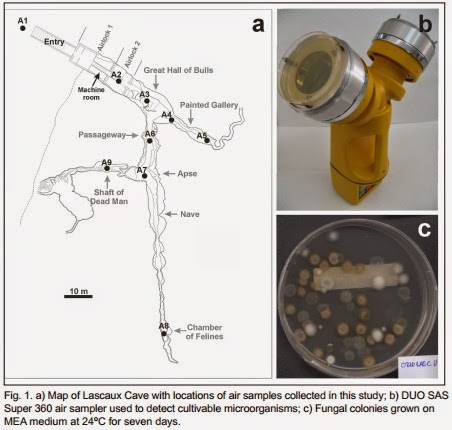
Microorganismos en el aire en la Cueva de Lascaux (Francia)

Acaba de publicarse un trabajo sobre los microorganismos en el aire en la Cueva de Lascaux (Francia) en la revista International Journal of Speleology, firmado por Pedro M Martin-Sanchez, Valme Jurado, Estefania Porca, Fabiola Bastian, Delphine Lacanette, Claude Alabouvette y Cesareo Saiz-Jimenez.


Recordemos que la Cueva de Lascaux tiene unas pinturas rupestres maravillosas y tuvo que ser cerrada por el continuo paso de visitantes a su interior. En ella se están realizando multitud de trabajos en torno al estudio de las pinturas y los restos arqueológicos, así como su conservación... de ahí este fabuloso trabajo que podéis ver completo PINCHANDO AQUÍ.

No obstante, os dejo el resumen en inglés para ir abriendo boca:

ABSTRACT:
Lascaux Cave in France contains valuable Palaeolithic paintings. The importance of the paintings, one of the finest examples of European rock art paintings, was recognized shortly after their discovery in 1940. In the 60’s of the past century the cave received a huge number of visitors and suffered a microbial crisis due to the impact of massive tourism and the previous adaptation works carried out to facilitate visits. In 1963, the cave was closed due to the damage produced by visitors’ breath, lighting and algal growth on the paintings. In 2001, an outbreak of the fungus Fusarium solani covered the walls and sediments. Later, black stains, produced by the growth of the fungus Ochroconis lascauxensis, appeared on the walls. In 2006, the extensive black stains constituted the third major microbial crisis. In an attempt to know the dispersion of microorganisms inside the cave, aerobiological and microclimate studies were carried out in two different seasons, when a climate system for preventing condensation of water vapor on the walls was active (September 2010) or inactive (February 2010). The data showed that in September the convection currents created by the climate system evacuated the airborne microorganisms whereas in February they remained in suspension which explained the high concentrations of bacteria and fungi found in the air. This double aerobiological and microclimate study inLascauxCave can help to understand the dispersion of microorganisms and to adopt measures for a correct cave management.

IMAGEN EXTRAÍDA DEL TRABAJO ANTERIORMENTE CITADO.

miércoles, 9 de julio de 2014

Estudios de nematodos en cuevas de Jaén

El estudio de nematodos en cuevas de Jaén se está llevando desde hace cerca de 10 años por la Universidad de Jaén, concretamente por el profesor y doctor Joaquín Abolafia Cobaleda, en colaboración con el Grupo de Espeleología de Villacarrillo (G.E.V.).


Se acaba de publicar un nuevo trabajo sobre nematodos de cuevas de Jaén, firmado por el Joaquín Abolafia Cobaleda y Jaime Lechuga Puñal, publicado en la revista digital internacional GOTA A GOTA nº 5 en su sección de Bioespeleología. Podéis descargar el trabajo pinchando en el siguiente enlace:


Un trabajo excelente.

martes, 8 de julio de 2014

Biología y Ecología de la Cueva de los Murciélagos

En un reciente trabajo publicado en la revista internacional Journal of Cave and Karst Studies, se hace referencia a la biología y la ecología de la Cueva de los Murciélagos del Parque Nacional del Gran Cañón de Arizona (Estados Unidos), firmado por Robert B. Pape.


El resumen de este trabajo en inglés es el siguiente:

ABSTRACT:

A study of the biology and ecology of Bat Cave, Grand Canyon National Park, was conducted during a series of four expeditions to the cave between 1994 and 2001. A total of 27 taxa, including 5 vertebrate and 22 macro-invertebrate species, were identified as elements of the ecology of the cave. Bat Cave is the type locality or Eschatomoxys pholeter Thomas and Pape (Coleoptera: Tenebrionidae) and an undescribed genus of tineid moth, both of which were discovered during this study. Bat Cave has the most species-rich macro-invertebrate ecology currently known in a cave in the park.

El trabajo completo lo podéis leer pinchando en el siguiente enlace: DOI: http://dx.doi.org/10.4311/2012LSC0266